
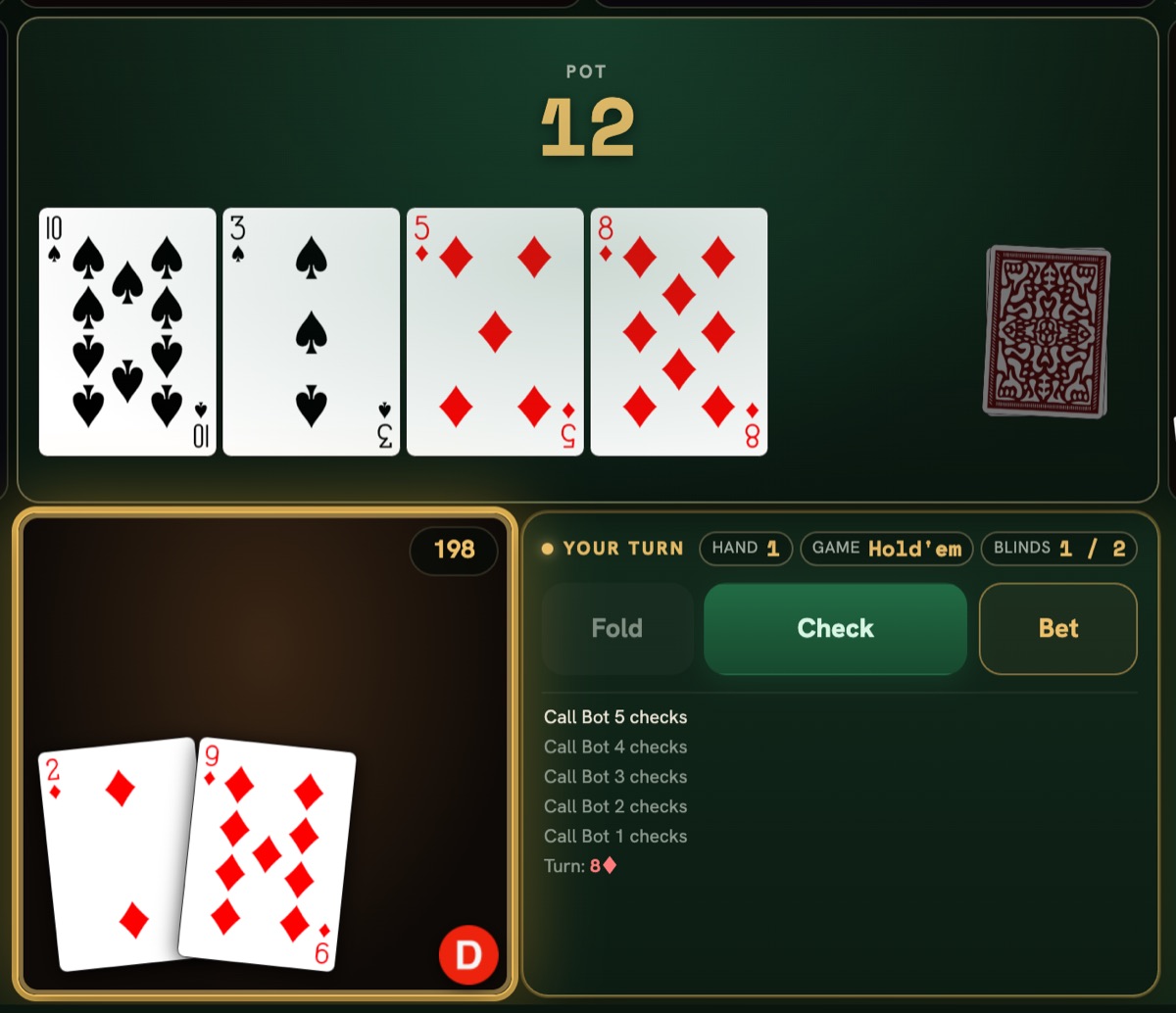
You're on a flush draw. Someone bets. Should you call? Most casual players answer that with a gut feeling. You can answer it with one quick division problem, and it takes about five seconds once you've done it a few times.
Pot odds in one sentence: divide the amount you have to call by the total pot after your call. That's how often you need to win to break even. If your chance of hitting is higher than that, call. If it's lower, fold.
Everything else in this article is just how to get those two numbers quickly at the table.
Number one: what the pot is asking you to pay
Say the pot is 60 and your opponent bets 20. The pot is now 80, and it costs you 20 to call. If you call, the final pot is 100, and you put in 20 of it.
20 ÷ 100 = 20%. You need to win this hand at least 20% of the time for the call to pay off over the long run.
Players often say this as a ratio instead: "the pot is offering 4-to-1" (80 in the pot, 20 to call). Same thing. A 4-to-1 price means you need to win 1 time in 5, which is 20%.
You don't even need to do the division every time. The bet size relative to the pot tells you the answer:
| Opponent bets... | Pot odds | You need to win at least |
|---|---|---|
| A quarter of the pot | 5-to-1 | 16.7% |
| A third of the pot | 4-to-1 | 20% |
| Half the pot | 3-to-1 | 25% |
| Two-thirds of the pot | 2.5-to-1 | 28.6% |
| The size of the pot | 2-to-1 | 33.3% |
| Twice the pot | 1.5-to-1 | 40% |
If you remember only one row, make it this one: a half-pot bet means you need 25%.
Number two: how often you'll hit, starting with your outs
An out is a card that's still in the deck and would give you what you think is the winning hand. Counting outs is just counting the cards that help.
The five draws you'll see most often:
| Draw | Example (your cards, then the board) | Outs |
|---|---|---|
| Flush draw | A♥ 7♥ on K♥ 9♥ 2♣ | 9 |
| Open-ended straight draw | 8♠ 7♦ on 9♣ 6♥ 2♠ (any 10 or 5) | 8 |
| Gutshot (inside straight draw) | 8♠ 7♦ on 10♣ 6♥ 2♠ (any 9) | 4 |
| Two overcards | A♠ Q♦ on 9♣ 6♥ 2♠ (any A or Q) | 6 |
| Flush draw + open-ended straight draw | 8♥ 7♥ on 9♥ 6♥ 2♣ | 15 |
Where those numbers come from: a suit has 13 cards, you can see 4 of them, so 9 are left. An open-ended straight draw can be completed by any of four cards at either end: 4 + 4 = 8. A gutshot needs one specific rank: 4. The combo draw has 9 flush cards plus the six non-heart 10s and 5s: 15.
One caution: not every out is clean. Pairing your ace with two overcards is often good, but not always. And sometimes a card that completes your hand helps someone else more. Be a little pessimistic with marginal outs.
The rule of 4 and 2
Now turn outs into a percentage. There's a shortcut almost every player uses:
- With one card to come, multiply your outs by 2.
- With two cards to come, and no more betting before you see both, multiply your outs by 4.
Here's how close the shortcut gets, compared with the exact odds:
| Outs | One card: ×2 | Exact | Two cards: ×4 | Exact |
|---|---|---|---|---|
| 4 | 8% | 8.7% | 16% | 16.5% |
| 6 | 12% | 13.0% | 24% | 24.1% |
| 8 | 16% | 17.4% | 32% | 31.5% |
| 9 | 18% | 19.6% | 36% | 35.0% |
| 15 | 30% | 32.6% | 60% | 54.1% |
(The exact one-card odds use the river card with 46 unseen cards; the two-card odds are from the flop, with 47 unseen cards and two cards to come.)
Two things worth knowing:
- Use ×4 only when you're sure to see both cards. That means someone is all-in on the flop. If there's going to be another bet on the turn, you're really paying for one card at a time, so use ×2 now and do it again on the turn.
- ×4 overstates big draws. With 15 outs it says 60%, but the truth is about 54%. A simple fix: above 8 outs, subtract the number of outs over 8. For 15 outs: 60 − 7 = 53%. Close enough.
Putting it together: three worked hands
All three are on the turn, with one card to come, so it's outs × 2.
Hand 1: an easy call
You hold A♥ 7♥. The board is K♥ 9♥ 2♣ 5♠. You have a flush draw: 9 outs. The pot is 80, and your opponent bets 10.
- Price: the pot is now 90 and you call 10, for a final pot of 100. 10 ÷ 100 = 10%.
- Chances: 9 outs × 2 = 18% (exactly 19.6%).
18% is well above 10%. Call. Small bets against big draws are almost always calls. You'd be getting paid even before counting the times an ace on the river wins it for you.
Hand 2: an easy fold
You hold 8♠ 7♦. The board is 10♣ 6♥ 2♠ K♦. Only a 9 makes your straight: a gutshot with 4 outs. The pot is 50, and your opponent bets 50, the size of the pot.
- Price: the pot is now 100 and you call 50, for a final pot of 150. 50 ÷ 150 = 33%.
- Chances: 4 outs × 2 = 8% (exactly 8.7%).
You'd need to win a third of the time, and you'll win fewer than one time in ten. Fold, and don't think about it again.
Hand 3: a close one
You hold 8♠ 7♦. The board is 9♣ 6♥ 2♠ Q♦. Any 10 or 5 gives you a straight: an open-ended draw with 8 outs. The pot is 80, and your opponent bets 20.
- Price: the pot is now 100 and you call 20, for a final pot of 120. 20 ÷ 120 = 16.7%.
- Chances: 8 outs × 2 = 16% (exactly 17.4%).
That's basically break-even. When the math is this close, two questions decide it:
- If you hit, will you win more? When the 5 or 10 comes, will your opponent bet or call on the river? If yes, the money you win later makes this call profitable. Players call this implied odds.
- Are your outs clean? Here, a 10 on the river would give anyone holding K-J a higher straight than yours. It's unlikely, but it's a reason to count the 10s as slightly less than full outs.
If your opponent is the type to pay off, call. If they'll shut down the moment a straight card comes, fold. Either one is a fine decision, which is exactly what "close" means.
When to ignore the math
Pot odds are a tool, not a rule you owe anyone. At a friendly table, some spots aren't worth the arithmetic:
- Tiny pots. If calling costs 2 chips, just call when you're curious. The math matters when the chips matter.
- When you're learning the game. Sometimes seeing how a hand plays out is worth a few chips. Just know that you're paying for the lesson.
- When you're having fun. You came to hang out. If chasing a long-shot straight is what makes your night, chase it, and enjoy it when it lands.
What the math is great for is the big decisions, the ones where half your stack is on the line and a gut call can end your night early. That's where five seconds of division pays for itself.
If you want more practice spotting draws and hands, it helps to know your starting hands and hand rankings cold, and to be clear on how betting works. Then the only thing left to do at the table is count to nine.
Frequently asked questions
What are pot odds in simple terms? The price of a call compared to the size of the pot. Divide what you have to call by the total pot after your call, and that's the share of the time you need to win to break even.
How do I count outs in poker? Count the unseen cards that would give you the winning hand. A flush draw has 9, an open-ended straight draw has 8, and a gutshot straight draw has 4.
What is the rule of 4 and 2? A shortcut for turning outs into a percentage: multiply your outs by 4 with two cards to come (when you'll see both without another bet), or by 2 with one card to come.
What are implied odds? The chips you expect to win on later streets if you hit your draw. They can make a call worth it even when the current pot odds are a little short.
Should I use the rule of 4 on the flop? Only if you're all-in or someone else is, so you're guaranteed to see both the turn and the river. If there will be another bet on the turn, use the rule of 2 and decide again when the turn comes.