
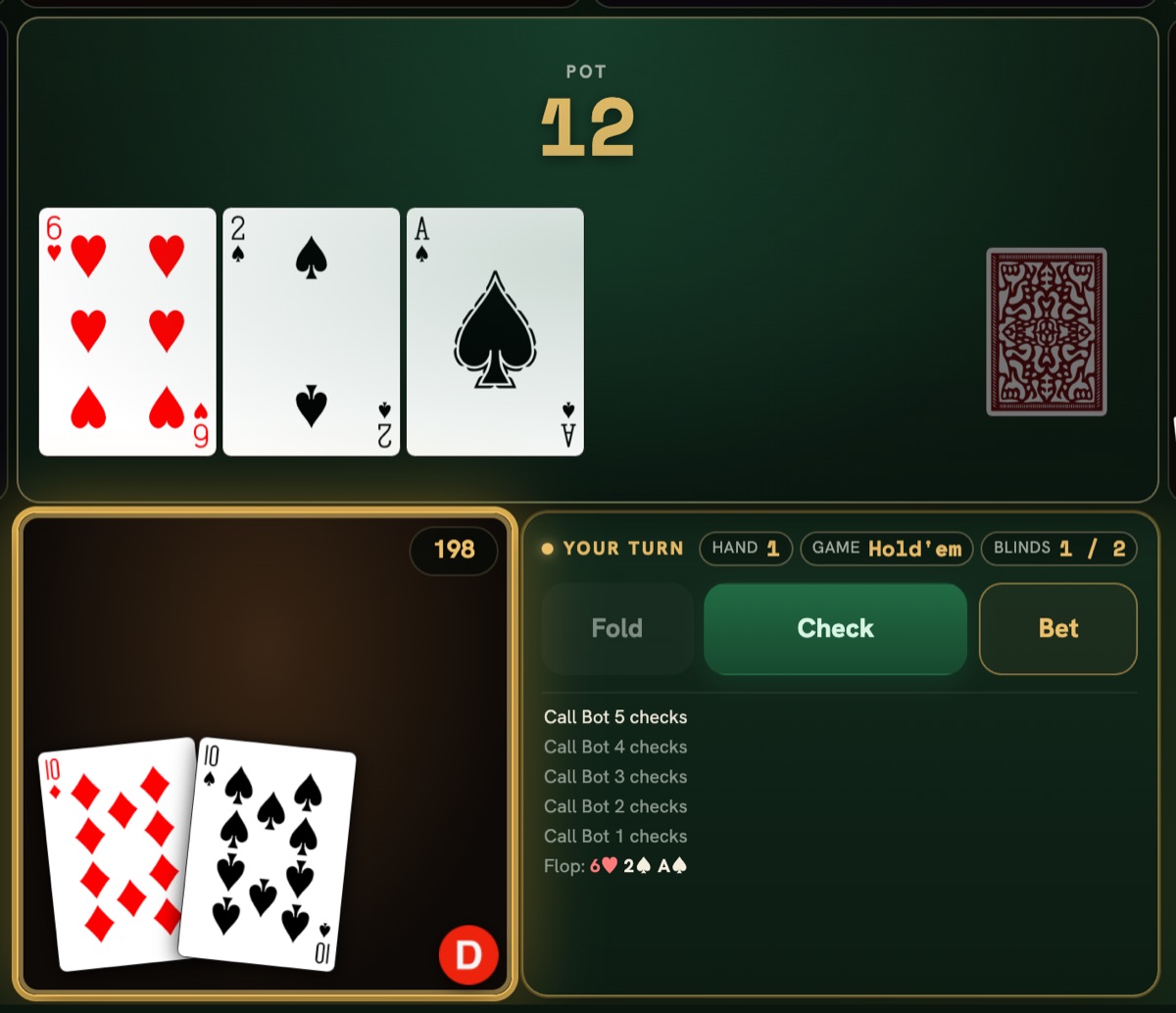
The short answer: in Texas Hold'em, play pairs, big aces, and big suited cards, and fold most of everything else. A sensible starting range for a casual player is about one hand in six. That means folding roughly five hands out of six before the flop, and playing the hands you keep a bit more aggressively than feels natural.
That sounds boring. It's actually the opposite: when you only play good hands, you spend the night in pots you can win, instead of paying to watch your 9-4 lose to someone else's 9-8.
Why folding is the biggest upgrade a casual player can make
At most friendly tables, the most common leak isn't bluffing too much or betting the wrong size. It's simply playing too many hands. Every time you call with a weak hand, you're paying to enter a pot where you'll usually finish second, and second place in poker pays nothing.
Weak hands cost you in two ways:
- They miss. Most of the time, two random cards make nothing on the flop, and you've paid to find that out.
- They hit second-best. This is the expensive one. You pair your king, your opponent pairs the same king with a better kicker, and now you're losing a big pot with a hand that felt strong.
Folding costs you nothing but a few blinds. That's the trade.
The starting hand tier list
Hands below are written the way players say them: "s" means suited (both cards the same suit), "o" means offsuit. A pair like 7-7 is always two different suits.
- Premium: A-A, K-K, Q-Q, J-J, A-K (suited or not). Raise from any seat, and re-raise if someone raised before you.
- Strong: 10-10, 9-9, A-Q (suited or not), A-J suited, K-Q suited. Raise from any seat.
- Speculative: 8-8 down to 2-2; suited aces from A-10s down to A-2s; suited connectors from J-10s down to 5-4s; K-Js, K-10s, Q-Js, Q-10s; and A-J and K-Q offsuit. Play from late seats, or when it's cheap to see the flop.
- Trash: everything else. Fold.
Here's how often you'll be dealt a hand from each tier, out of the 1,326 possible two-card combinations:
| Tier | Combinations | How often |
|---|---|---|
| Premium | 40 | 3.0% (1 hand in 33) |
| Strong | 36 | 2.7% (1 hand in 37) |
| Speculative | 146 | 11.0% (1 hand in 9) |
| Trash | 1,104 | 83.3% |
Premium plus strong is only about 1 hand in 17. Add the speculative tier and you're playing about 1 hand in 6, which is a great place to start.
If a hand isn't on the list, it's in the trash tier. That includes some hands that look pretty: Q-9 offsuit, K-7 suited, J-8 offsuit, any "ace-rag" offsuit like A-6. Folding them will feel wrong at first. It's still right.
Why your seat changes everything
The same hand can be a fold in one seat and a raise in another. The reason is simple: the more players still to act behind you, the more likely one of them has you beaten.
Say you hold K-J. Here's the chance that at least one player still to act behind you was dealt an ace:
| Players left to act | Chance at least one holds an ace |
|---|---|
| 1 | 15.5% |
| 2 | 29.1% |
| 3 | 41.1% |
| 5 | 60.3% |
| 8 | 79.9% |
Not every one of those aces will play, but enough of them will to make the point. Raising K-J first to act at a nine-player table, you're likely walking into trouble. On the button, with only the two blinds left to act, K-J is a perfectly good raise.
Late position has a second advantage: after the flop, you act last on every round, so you see what everyone else does before you decide. That's why the speculative tier is marked "late seats." These hands need to make something on the flop, and acting last makes it much cheaper to find out whether they did. (If the betting order is new to you, our Hold'em rules guide walks through it.)
Small pairs and suited connectors: fun hands with a catch
These are the hands that win the biggest, most memorable pots. They're also the hands that quietly drain your stack when you play them in the wrong spots.
Small pairs (2-2 through 8-8) are mostly hoping to flop three of a kind. That happens about once every 8.5 flops (11.8% of the time). When it misses, you usually have a small pair facing overcards, and you're done with the hand. So the math works like this: to break even on a call, you need to win about 7.5 times what you called on the times you hit, and more in practice, because a set doesn't always get paid and occasionally loses. Small pairs play best when the call is cheap and the stacks behind are deep. Calling 2 chips to win a potential 50 is great. Calling 20 to maybe win 60 is not.
Suited connectors (like 7-6s or 9-8s) are hoping to flop a straight or flush draw. Being suited helps, but less than people think. With two suited cards, you'll finish with a flush only about 6.4% of the time by the river. Here's what suitedness is worth head-to-head, worked out over every possible board:
| Matchup | Suited wins | Offsuit wins |
|---|---|---|
| J-10 vs A-K (offsuit) | 41.2% | 37.4% |
| 8-7 vs A-A | 23.0% | 18.7% |
A few percentage points: real, but not enough to turn a bad hand into a good one. These hands are worth playing when it's cheap to see the flop, when several players are in (so the pot is big if you hit), and when you're in late position.
The trap hands that cost beginners the most
These hands win just often enough to keep you playing them, which is exactly what makes them expensive. The problem is domination: when you and an opponent share a card, the one with the better second card is a big favorite.
| Your hand | Against | You win |
|---|---|---|
| K-10o | K-Q | 26.7% |
| K-10o | A-K | 26.5% |
| A-5o | A-K | 27.8% |
| A-5s | A-K | 32.0% |
| Q-Jo | A-Q | 27.5% |
Some trap hands to watch for:
- Any ace. About 15% of starting hands contain an ace, and new players play every one of them. A-7 offsuit makes a pair of aces and loses to A-Q, and you'll put a lot of chips in before you find out.
- K-10, Q-10, J-9 offsuit. Two "face-ish" cards that are rarely the best version of the hand someone else is also playing.
- "But they're suited!" K-4 suited is still K-4. As the table above shows, suits add a few percent. They don't rescue a hand that's already in trouble.
- Any two cards in the big blind, after a raise. You've already put chips in, so it feels like you should defend. But those chips are gone either way, and calling a raise with trash is the same mistake with a better excuse.
A dead-simple plan for your first ten game nights
You don't need charts taped to the table. Use this until it's automatic:
- First few to act at a full table: play the premium and strong tiers only, and raise when you play. Don't just call.
- On the button and the two seats to its right: add the speculative tier. If nobody has raised yet, raise. If someone has, call with small pairs and suited connectors only when it's cheap.
- Facing a raise: re-raise with A-A, K-K, Q-Q and A-K. Call with the rest of the premium and strong tiers. Fold almost everything else.
- In the big blind with no raise: you can check and see the flop for free with any two cards. Free is the right price for trash.
- When you raise first, a standard size is about 3 big blinds, plus 1 more for each player who already called. Keep it the same with every hand so your bet size doesn't give your cards away.
Once those habits feel natural, you'll start to see the spots where loosening up makes sense, like stealing the blinds from the button when the players behind you fold a lot. And when you're deciding whether to keep chasing a draw after the flop, that's a pot odds question, which is easier than it sounds.
The best way to make folding feel normal is to watch a lot of hands without paying for them. The no-signup practice table deals you in against bots, so you can fold your way through twenty hands and notice how rarely the trash would have won.
Frequently asked questions
What percentage of hands should a beginner play? Somewhere around 15 to 20% is a solid starting point. The tiers above add up to about 17%.
What is the best starting hand in Texas Hold'em? Pocket aces. Against pocket kings, the second-best hand, aces win about 82.6% of the time.
Is A-K better than a pair? It depends on the pair. A-K suited against Q-Q wins 46.2% of the time, so it's a slight underdog to a big pair. Against any small pair, like 2-2, it's close to a coin flip, but the pair is still a small favorite (52.6% for 2-2 against A-K offsuit).
How many starting hands are there in Hold'em? There are 1,326 possible two-card combinations, which group into 169 different hands once you ignore which specific suits they are (13 pairs, 78 suited, 78 offsuit).
Should I ever play 7-2 offsuit? Only as a joke you're prepared to pay for. It's widely considered the worst starting hand in Hold'em.