
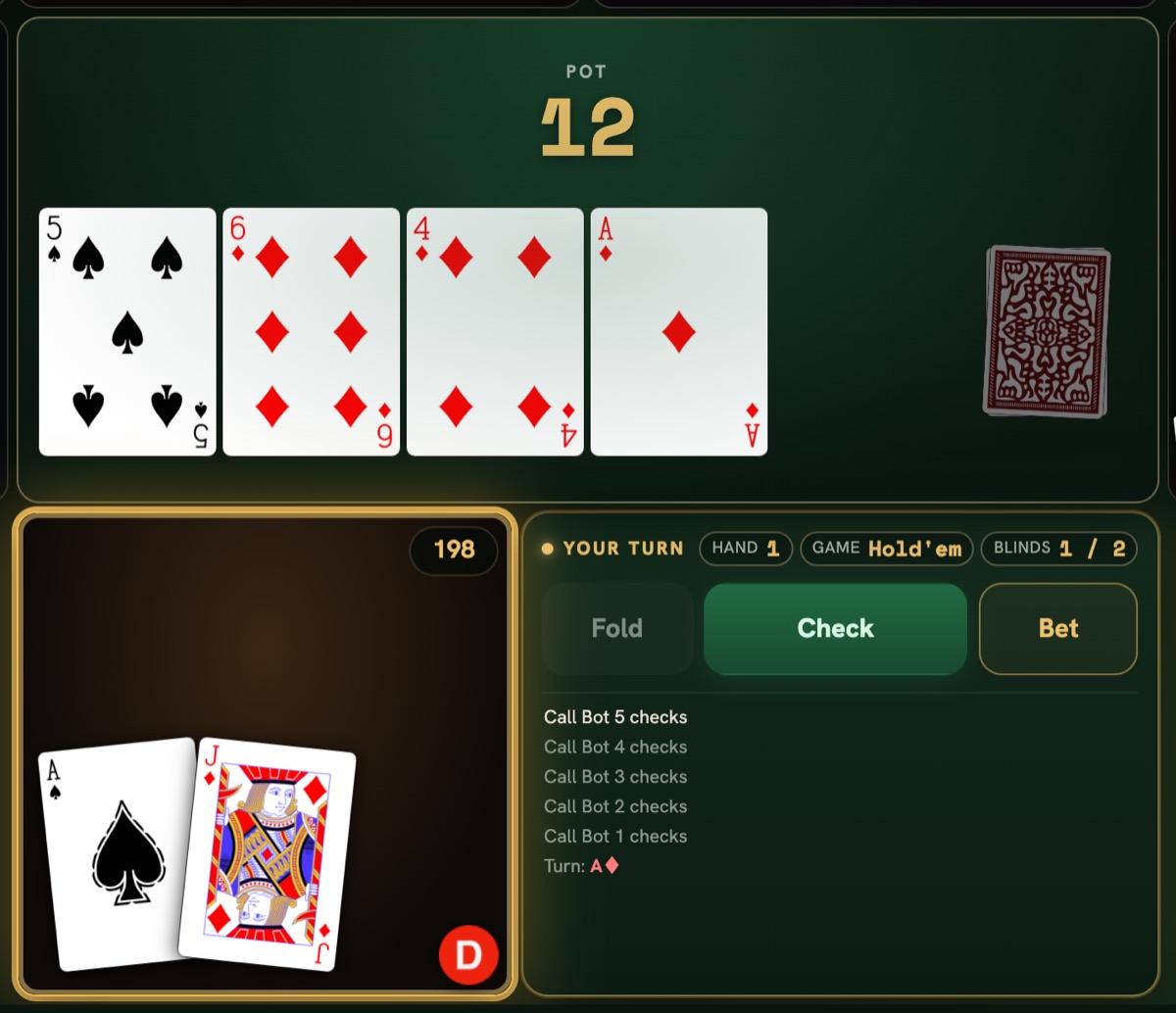
Texas Hold'em is simple to learn and takes a lifetime to get good at, but the "simple to learn" part really is simple. Here's the whole game in one breath:
Every player gets two private cards. Five shared cards are dealt face up in the middle, in three stages. There's a round of betting before the shared cards and after each stage. Whoever makes the best five-card hand out of their two cards plus the five on the board wins the pot, unless everyone else folds first.
That's it. Everything below is detail: who bets when, what your choices are, and how the pot gets awarded. If you can follow one example hand, you can sit down and play tonight.
How does a hand of Texas Hold'em work?
A hand has five stages. Four of them have betting:
| Stage | What gets dealt | Betting round? |
|---|---|---|
| Preflop | Two face-down "hole cards" each | Yes |
| Flop | Three community cards, face up | Yes |
| Turn | A fourth community card | Yes |
| River | A fifth and final community card | Yes |
| Showdown | Nothing; remaining players compare | No |
The community cards are called the board, and everyone shares them. Your hand is the best five cards you can make from your two hole cards and the five on the board. You can use both of your hole cards, one of them, or even neither (if the board itself is your best hand). Which hand beats which is covered in our hand rankings guide, and there's a printable cheat sheet if you want one on the table for your first night.
A hand can also end early. If someone bets and everyone else folds, that player wins the pot right there, and nobody has to show their cards.
What are the blinds and the dealer button?
Before any cards come out, two players are forced to put chips in. These are the blinds, and they exist so there's always something in the pot worth fighting for. Without them, everyone could wait around for pocket aces and nothing would ever happen.
- The dealer button is a marker that shows who is "on the button" (in a home game, usually also the person shuffling and dealing).
- The player to the button's left posts the small blind.
- The player to their left posts the big blind, usually twice the small blind. In our examples the blinds are 1 and 2 chips.
- After every hand, the button moves one seat to the left, so everyone takes a turn paying the blinds and everyone gets a turn on the button.
Heads-up exception: when only two players are left, the button posts the small blind, acts first before the flop, and acts last after it.
Who acts first in Texas Hold'em?
Action always moves clockwise (to the left), one player at a time.
- Preflop, the first player to act is the one to the left of the big blind (called under the gun). The big blind acts last, and if nobody has raised, the big blind still gets the option to raise.
- On the flop, turn, and river, the first player still in the hand to the left of the button acts first, and the button acts last.
Acting last is a real advantage, because you get to see what everyone else did before you decide. That's why players talk so much about position, and why the starting hands you play should depend on where you sit.
Your options on every turn: check, bet, call, raise, fold
When it's your turn, which options you have depends on one question: has anyone bet yet in this round?
| If nobody has bet yet... | If someone has bet... |
|---|---|
| Check: pass without betting | Call: match the bet to stay in |
| Bet: put chips in for others to match | Raise: increase the bet |
| Fold: give up (allowed, but pointless when you could check for free) | Fold: give up your cards and any chips already in |
A betting round ends when every player still in the hand has put in the same amount, or has gone all-in (bet every chip they have). Then the next card comes. In no-limit Hold'em, the version almost every home game plays, you can bet any amount up to your whole stack. The smallest bet allowed is the big blind, and a raise has to be at least as big as the last bet or raise. Minimum raises and side pots trip up a lot of tables, so we gave them their own guide.
What do the actions tell everyone else? Roughly: a check says "I'm not pushing," a bet or raise says "I like my hand (or want you to think so)," and a call says "I'm interested, but not enough to raise." That's the whole conversation of poker, and why bluffing works at all.
One complete hand, walked through
Four friends, blinds of 1 and 2. Maya has the button, Sam is the small blind, Alex is the big blind, and Theo is under the gun.
Preflop. Sam posts 1 and Alex posts 2. Cards are dealt. Theo looks at J♣ 10♣ and calls 2. Maya has A♠ K♦ and raises to 6. Sam folds, leaving his 1 chip in the pot. Alex calls (4 more, for 6 total), and Theo calls 4 more. Pot: 1 + 6 + 6 + 6 = 19.
Flop: K♠ 9♦ 4♣. Sam has folded, so Alex is first to act. Alex checks. Theo checks. Maya, who now has a pair of kings with an ace kicker, bets 10. Alex folds. Theo calls with a draw: any queen gives him a straight. Pot: 39.
Turn: 2♥. No help for Theo. He checks, and Maya checks behind. Pot: still 39.
River: J♠. Theo pairs his jack and bets 15. Maya calls. Pot: 69.
Showdown. Theo made the last bet, so he shows first: J♣ 10♣ for a pair of jacks (J-J-K-10-9). Maya shows A♠ K♦: a pair of kings with an ace (K-K-A-J-9). Kings beat jacks, so Maya takes the 69-chip pot. Then the button moves one seat to the left, to Sam, and the next hand begins.
Want to see one of these play out without dealing a single card? The no-signup practice table deals you into a hand against bots, so you can click through the rounds at your own pace.
Showdown: who shows first, and how the pot is awarded
If two or more players are still in after the river betting, there's a showdown:
- If there was a bet on the river, the last player to bet or raise shows first. If everyone checked the river, the first player to the left of the button shows first, and it goes around from there.
- A player who can't win may muck (throw away their cards face down) instead of showing. That's legal, but think twice: a mucked hand is dead and can't win even if you misread it.
- Cards speak. Your hand is whatever your cards make, not what you announce. If you say "pair" but actually have a flush, you have a flush. Table your cards and let everyone read them.
- Split pots. If two players have the same five-card hand, they split the pot evenly. Suits never break ties. If the board itself is the best hand for everyone (say, a straight on the board that nobody can beat), every player still in the hand splits it.
The five rule mix-ups that cause the most arguments
- "You have to use both hole cards." Not in Hold'em. Your best five out of seven can use two, one, or zero of your hole cards. (The must-use-two rule is Omaha.)
- String betting. Putting some chips in, then reaching back for more, is a "string bet," and it only counts as a call. If you want to raise, say "raise" out loud before your chips move, or push them all in one motion.
- The one-chip call. Tossing in a single big chip without saying anything counts as a call, not a raise. Facing a bet of 10 and throwing a 25 chip in silently means you called 10.
- Acting out of turn. Folding or betting before it's your turn gives away information to the players who haven't acted yet. Wait your turn, even when you already know you're folding.
- Throwing away a winner. New players sometimes muck a hand they think lost, only to learn their kicker played. When it reaches showdown and you're not sure, turn your cards face up.
Every group also has its own little rules on top of these, like whether you can rebuy, or what happens if a card gets flipped by accident. It's worth agreeing on them before the first deal; our house rules checklist covers the usual ones.
Glossary: 15 terms you'll hear on your first night
| Term | Meaning |
|---|---|
| Hole cards | Your two private cards |
| Board | The five community cards everyone shares |
| Flop | The first three community cards |
| Turn | The fourth community card |
| River | The fifth and last community card |
| Button | The dealer position; acts last after the flop |
| Blinds | Forced bets posted by the two players left of the button |
| Under the gun | The first player to act before the flop |
| Position | Where you act in the order; later is better |
| All-in | Betting every chip you have left |
| Pot | All the chips bet so far in the hand |
| Kicker | The highest unpaired card, used to break ties |
| Muck | To fold, or throw your cards away unshown |
| Showdown | Revealing hands after the final betting round |
| Chop | Splitting the pot between tied hands |
Frequently asked questions
How many cards do you get in Texas Hold'em? Two private cards each, plus five community cards shared by everyone, for seven cards to choose your best five from.
Can you check after someone bets? No. Once there's a bet in the current round, your options are call, raise, or fold. Checking is only allowed when nobody has bet yet in that round.
What happens if nobody bets after the flop? The cards keep coming, and if everyone checks all the way through the river, the best hand at showdown wins whatever went in before the flop.
Who deals in a home game? Usually whoever has the button, and the deal rotates with it. If nobody wants to shuffle at all, an app can deal for you; Table Talk puts the board on a TV and your cards on your phone.
How many players can play Texas Hold'em? Two to ten at one table is standard. Six to nine is the sweet spot for a home game.